
Trigg County Court Records After Arrest
After a Trigg County arrest, two records start to move on parallel tracks. The jail record documents intake, custody, booking charge, bond, hold, release, or transfer. The court record documents the legal case filed in Trigg District or Circuit Court. The Kentucky Court of Justice Trigg County page lists the local court at 41 Main St. in Cadiz and identifies Circuit Court Clerk Lisa Thomas as the record route for county court files.
Court records after a jail arrest should not be confused with jail inmate records. A roster charge is an intake label. A court charge is the charge accepted, filed, amended, dismissed, reduced, or prosecuted in the case. Booking photos and intake images belong on the Trigg County jail mugshots side of the record path, not in the court case database.
Kentucky uses county attorneys and commonwealth's attorneys rather than the district attorney title. The Trigg County official elected-officials page lists County Attorney Randy Braboy at 38 Main Street, A2. County attorneys commonly handle misdemeanors, traffic, juvenile or status matters, preliminary felony stages, and local prosecution roles. Felony cases may move into Circuit Court after indictment or information.
Find Trigg County Court Records After Arrest
The first formal court-record route is the Kentucky Court of Justice system. The Kentucky eCourt / CourtNet portal is a statewide electronic access route for registered users, but it is not a simple anonymous jail roster. When portal access is unavailable, login-gated, incomplete, or restricted, the local circuit court clerk is the public fallback for case-copy requests and older files.
- Search the Kentucky eCourt / CourtNet portal if you have authorized access.
- Use defendant name, case number, citation number, arrest date, or county filter when available.
- Distinguish District Court from Circuit Court because early felony stages may begin in District Court.
- Open the case entry and read the charge list, status, bond orders, hearing history, and disposition.
- Call or visit the Trigg Circuit Court Clerk when the portal does not show the record or a certified copy is needed.
The Kentucky Court of Justice request page is the statewide route for court-record instructions. The court-record request instructions are shown below from the image manifest.
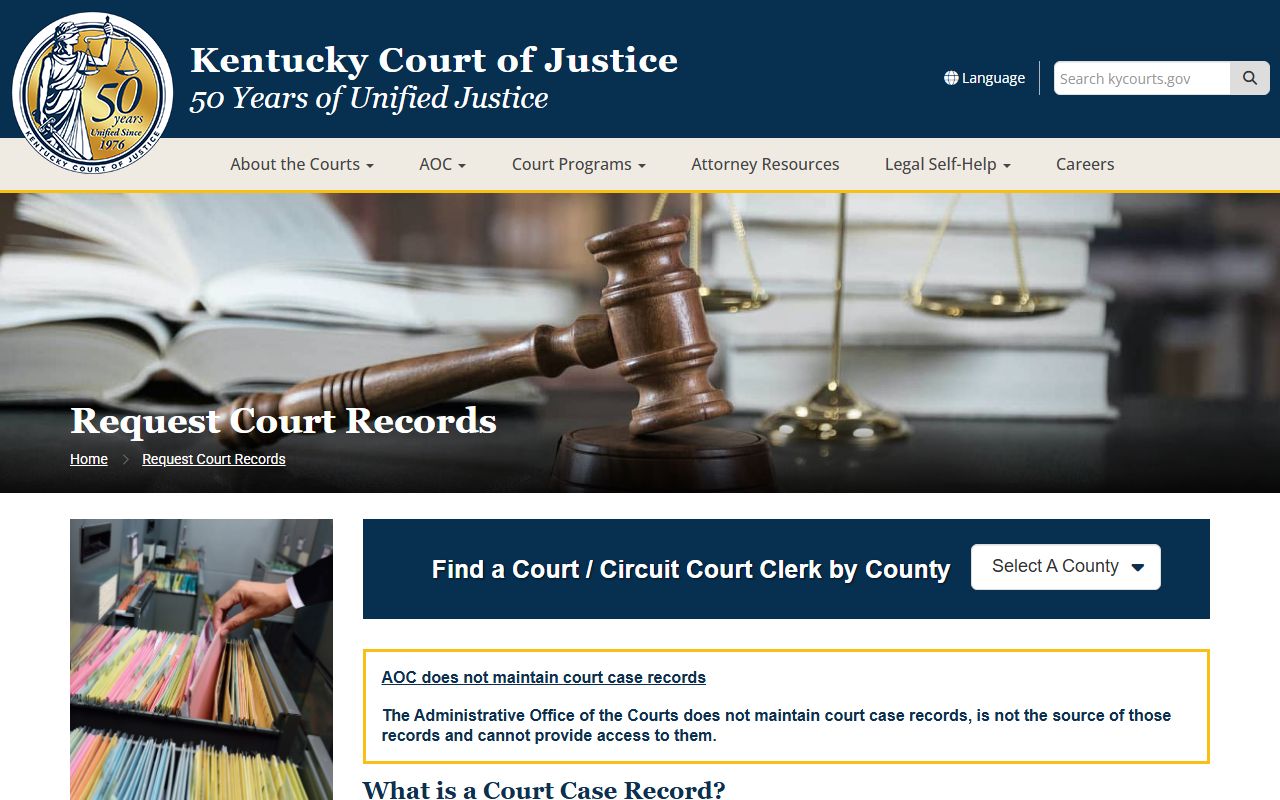
Use the request channel when the question is about copies, certification, or complete case history rather than current jail custody.
Trigg County Court Search Fields
CourtNet and eCourt access depends on login status and user authorization. The research captured the field categories rather than a public anonymous search form. When searching, exact identifiers are stronger than broad name searches, and a court case result should be checked against date of birth or other lawful identity details before relying on it.
| Field Label | Type | Required | Notes |
|---|---|---|---|
| Username / email | Text | Yes | Login credential for authorized or registered access. |
| Password | Password | Yes | Portal access requires login. |
| Case number | Text | Optional after login | Best exact search field when known. |
| Party / defendant name | Text | Optional after login | Use full name; verify identity where lawful. |
| County / court | Filter | Optional | Use Trigg and distinguish District from Circuit. |
Charges Filed After a Trigg Arrest
The arrest-to-charge path is not automatic in the public record. An officer may make an arrest or issue a citation. Booking creates a custody record. The prosecutor reviews the allegations. Charges may then be filed by complaint, citation, information, or indictment, depending on the offense and stage. First appearance and bond often begin in District Court, while felonies may move to Circuit Court after indictment, waiver, or information.
| Document | Who Uses It | Common Role |
|---|---|---|
| Complaint or citation | Officer or prosecutor | Starts many misdemeanor, traffic, and early criminal matters. |
| Information | Prosecutor | Formal charging document used in some felony case paths. |
| Indictment | Grand jury | Formal felony accusation returned after grand-jury review. |
A jail roster entry can remain useful even after the case opens, but the court record controls what charge is pending in court. If a booking charge and court charge do not match, use the court record for the case status and the jail record for custody status.
Trigg County Charge Status Records
Charges can change as a case moves through court. A pending charge may be amended, reduced, dismissed, diverted, replaced by an indictment, or resolved by plea, trial, acquittal, or conviction. Never treat an arrest charge as a conviction. The final meaning of the record depends on the disposition entered by the court.
| Status | What It Means |
|---|---|
| Pending | The charge is open and has not reached final disposition. |
| Amended or reduced | The filed charge changed, often through prosecutor review or plea terms. |
| Dismissed | The charge was ended without a conviction on that count. |
| Diversion | The case may be resolved through court-approved conditions instead of ordinary conviction handling. |
| Convicted | A guilty plea, verdict, or other conviction disposition was entered. |
Bond Orders After Trigg County Arrest
Bond begins as a custody question but becomes a court-order question. The roster may display a bond amount or hold, but the judge's order controls release conditions. Kentucky bond types include cash, surety, personal-recognizance or unsecured release, and no-bond holds. A cash or surety bond may not lead to release if another warrant, parole hold, probation hold, federal hold, or ICE detainer is active.
| Bond Type | How It Works |
|---|---|
| Cash bond | Money is posted directly under court or jail instructions. |
| Surety bond | A licensed bail agent posts bond under a separate private agreement. |
| PR or unsecured release | The person is released based on a promise and court conditions. |
| No-bond hold | The person is not eligible for release unless the court changes the order. |
| Detainer or hold | Another agency can prevent release even if the local bond is posted. |
Warrants and Court Records After Arrest
No official Trigg County online active-warrant search was located. That does not mean no warrant exists. Warrant status can sit with the sheriff, the court clerk, another county, a state agency, or federal authorities. A bench warrant tied to missed court or noncompliance is usually a court-clerk question. A local arrest warrant or service question may be a sheriff question. A federal warrant is not controlled by the county roster.
Once a warrant is served and the person is booked, the serving jail roster may show custody. The underlying warrant or court case still needs the clerk or issuing court for reliable details. If a warrant may lead to arrest, legal advice should come from an attorney, not from a roster or informal phone summary.
Charges vs Convictions
A charge is an accusation in a court case. A conviction is a final legal outcome after a guilty plea, verdict, or other conviction entry. This difference is central to Trigg County court records after a jail arrest because the public may see an arrest, a booking charge, or a pending case long before any final court result exists.
| Charge | Conviction | |
|---|---|---|
| Stage | Accusation or pending count. | Final finding or plea outcome. |
| Proof level | Based on probable cause or filed allegation. | Entered after plea, verdict, or court finding. |
| Can change? | May be amended, reduced, dismissed, or replaced. | May later be appealed, vacated, sealed, or expunged when law allows. |
| Best source | Court case docket and charging document. | Final court disposition and sentencing record. |
Sealed and Expunged Arrest Records
Kentucky expungement and sealing rules are tied to eligibility, charge type, disposition, and waiting periods. The research routes expungement to KRS Chapter 431. A dismissed, acquitted, diverted, or otherwise eligible record may have a clearing path, but the court process controls that result. A jail or roster entry does not erase the court file by itself.
| Sealed | Expunged | |
|---|---|---|
| Public visibility | Hidden from ordinary public access. | Removed or treated under expungement rules when granted. |
| Access limits | Some agencies may retain limited access. | Access depends on Kentucky law and the order entered. |
| How it happens | By court order, not by a roster request alone. | By eligible petition or statutory process through the court. |
Restricted Trigg County Court Records
Kentucky open records and court access rules include limits. Juvenile material, sealed or expunged records, medical details, victim information, confidential informant information, and active law-enforcement material may be restricted or redacted. Court-copy fees and inspection rules may also apply under the court system or open-records law. Use the Kentucky Court of Justice request page and the local clerk for copy procedures instead of relying on an incomplete portal view.
Important: Court records after an arrest are not consumer reports and must not be used for FCRA-covered decisions.